08 August 2008

Whither The Khaliblog?

We have been thinking a lot about which direction this blog is heading.

When we started this blog, the three of us, Vini, Suni and Mai, we were very clear in our own minds what this blog was about. We had scoured the Internet and found a lot of information about the Indian atrocities of 1984, but very few personal stories. The main purpose of this blog was to help rectify this situation. We also hoped to be a platform where others could tell their personal stories.

The first purpose, we think, has been accomplished. Our stories are here; we've put a link to them a the top of the right hand column. Looking at Site Meter, we are pleased that those links are being used and our stories are being read.

We have been much less successful with our second objective. Only a very few have responded with their own stories. There might be several reasons for this. A big one is that many survivors don't have access to the 'Net, and many of those who do are either uncomfortable with English or unable to write in English. Another is that these stories are very difficult - painful - to tell, much less write. We hope that more will come forward. We do hope, as well, that our stories may have provoked discussions across generational lines about survivors' experiences. From e-mails we have received, we know that this is the case.

We would now like to issue an invitation to those who were not there, maybe not even born yet, to tell their own personal stories. Where were you when you first heard the news stories of these events? What was your reaction? Have you spoken to your elders about these things? What were their reactions? We would love to hear any such stories you would care to tell. Just send them to Mai at simayanan@gmail.com. We'll be happy to publish them, with or without your name, that's up to you. (Yes, anywhere on the 'Net you see 'Simayanan' no doubt that's Mai.)

Which brings us to this: For a long time now, Mai has been writing this on her own, with very little input from the rest of us. After some discussion, we feel we should officially turn The Road To Khalistan over to our Mai alone. Her health has improved and she seems able to handle it. We will always be here for backup and we both have her passwords (hehehehe), so we'll still be here in spirit. And if she gets too hot-headed, we'll try to rein her in a little - but only a little - her passion is one of the things we treasure about her.
So we two bow out and turn this over to Mai.


Go to it, Lady Khalsa!

Gurfateh and Chardi Kala to all!

Vini Kaur

Suni Kaur

*******************************************************

I admit that I'm a bit sad at dissolving our corporate person; at the same time, I am now more free to say what I want without clearing any controversial statements I may wish to make. Now I have complete editorial control, although, of course, my co-authors are always very welcome to contribute. When we started this blog, we were all inexperienced and very naive about the Internet. We didn't understand much about search engines and key words. We all thought that our little blog would be lost among the millions out there in the blogosphere. Little did we realise that putting 'Khalistan' in our title would get us noticed. I think that if we had realised, we would have found another name, something less conspicuous.. None of us wished to draw attention to ourselves and our very personal stories. I am pleased, though, that our stories are out there and being read, not because they are our stories, but because these stories need to be told.

Now it seems that I have a few decisions to make.


First, is there any point in continuing this blog? Yes, I think there is. We have a readership of about 45 each day, mostly from India, Canada, The USA and The UK - in that order. We also have a regular readership in Australia, Singapore and Malaysia. There are a few readers from other countries, too, some intrepid person in Oslo, Norway visits often, plus a smattering of readers in the Arabian Peninsula and Pakistan. We have occasional visitors from throughout Europe, Asia and Africa. Once in a great while, someone from South America stops in for a visit. There are a couple of maps in the right-hand column that you can check out, if interested.
As long as you keep reading, I'll keep writing. Is that a deal?

Second, what about content? I have pretty much been putting into this blog whatever comes up of a nature that I feel involved in as a Sikh. You'll keep hearing about the continuing saga of Brother Laibar Singh Ji, a person I am strongly committed to. An exception to this policy of covering all interesting things Sikh is that I have avoided involving this blog in the shenanigans of the High Muckety-Mucks in Amritsar. I find their manipulating Machiavellian machinations in Maya to be disgusting. Sikhi is my religion, my way of life, who and what I am. It is the core of my being, my great passion, my way of maneuvering through this life. It causes me great pain to see those who are supposed to be leading us acting like snot-nosed little brats who should be sitting on the 'naughty stool, not holding positions of power affecting all Sikh worldwide. I hate seeing one family set itself up as the Royal Family of Sikhdom - and it hurts me to see others accept their domination. That said, I do not see how my delving into this cesspool of dirty politics and ruthless, filthy ambition will in any way help my dear sisters and brothers, my fellow Sikhs. So I intend to continue to avoid these political issues. But my mind might be changed if it gets too outrageous.

I intend to change my profile picture each month to reflect some current Sikh issue. I might or might not write about it, but it will be there. Last month, I showed the damage caused to a brother's back by a lathi in Mumbai. How deeply we are loved and appreciated by these Indian people whom we have saved numerous times! I guess seeing Sikh blood gives them a feeling of power. Or something.

This month, I am using a portrait by the very talented and equally modest brother simmal tree. Our former header picture, We Are Going To Battle, is also from him..He allows me to freely use his pictures, asking only that I acknowledge Vahe guru. Since anything good we do is really Vaheguru, I love doing that. To see the discussion on this month's painting, go here. I would also suggest that you click on his photostream there and look at some of his own pictures. This portrait, Daughter(s) Of The Khalsa, has several meanings to me. First is the way we Kaurs seem to have no voice. I think we need to find our voice ourselves. This Singhni is not bound or tied. What is stopping her from taking the tape off her own mouth? I also see this as a metaphor for the way the government of India keeps trying to subdue and silence us Sikhs. I have no idea what it will take for them to realise the futility of their tactics.

Another note. According to a poll I took some time ago, the majority of readers of this blog are young men in their twenties, mostly from India. I am aware only a small percentage of readers answer polls, and I think that is probably accurate, although quite a few female readers have comminicated to me privately and I also know of several older people, hurray! I want to assure all of you that I will never let The Khaliblog - my personal name for The Road To Khalistan - degenerate into a feminist rag. There is one very good reason for this. I am not a feminist. I do believe in the equality - or rather the equivalency - of the sexes, as Sikhi clearly teaches. I do not believe one gender ought to dominate. And I do not believe in one of the feminists' key beliefs, abortion on demand, for both moral and practical reasons. And I do have an outrageous sense of humour that has been very unappreciated by the feminists I have known. So, while I will continue to write on women's issues as they arise, I will continue to write on whatever concerns me.

The remaining author, Kamal Kaur, is my dear friend and younger sister. The Internet being what it is, and given the volitile nature of our world, we have thought it prudent to preserve this blog outside of blogger. She is helping with this and needs administrative powers to help me. She has never written here, but I heartily hope she'll one day write about how she first learned about the events of 1984, events that occurred before she was even born. Come on, Kamal, please? I'll even proof read it for you, if you like.

(BTW, I am aware that many of my readers do not have English as their primary language. I promise to try to avoid using expressions like 'manipulating Machiavellian machinations' too often, but I love the English language and can't promise I'll be entirely successful. I have put a dictionary widget in the right hand column. If anyone knows of a widget that will translate English into Punjabi, please let me know. I've installed the one that translates into Spanish, French, Japanese, Chinese, etc., but I haven't found one for Punjabi.)

So where is this blog headed? The answer is I'm not sure, except that it is running headlong into the Sikh experience in the Twenty-First Century of the Common Era.

There is a saying, if you don't know where you're going, you'll probably end up somewhere else. So let us gather up our chardi kala and stride into that 'somewhere else,' 'the road less traveled by', with our integrity intact, our heads held high, and courage and joy in our hearts.


I shall be telling this with a sigh
Somewhere ages and ages hence:
Two roads diverged in a wood, and I—
I took the one less traveled by,
And that has made all the difference.

by Robert Frost
Mai Harinder Kaur

WHY TRY TO FIT IN?
YOU WERE BORN TO STAND OUT!

06 August 2008

"Now The Sun Has Come To Earth... - The Legacy Of Hiroshima And Nagasaki

Crossposted from sometimes - 2

WARNING: THIS POST CONTAINS A VERY DISTURBING PHOTOGRAPH OF DEAD BODIES FROM THE HIROSHIMA BLAST. IF YOU CAN'T TAKE IT, PLEASE GO READ SOMETHING ELSE. BUT I SINCERELY HOPE THAT YOU LOOK AND SEE AND THINK AND FEEL AND UNDERSTAND. AND WAKE UP.

***************************************


Sixty-three years ago today, the United States of America committed what is arguably the most serious war crime in history:


The sun is burning in the sky
Strands of clouds go slowly drifting by
In the park the lazy breeze
Are joining in the flowers, among the trees
And the sun burns in the sky


Now the sun is in the West
Little kids go home to take their rest
And the couples in the park
Are holdin' hands and waitin' for the dark
And the sun is in the West


Now the sun is sinking low
Children playin' know it's time to go
High above a spot appears
A little blossom blooms and then draws near
And the sun is sinking low

Now the sun has come to Earth
Shrouded in a mushroom cloud of death
Death comes in a blinding flash
Of hellish heat and leaves a smear of ash
And the sun has come to Earth


Now the sun has disappeared
All is darkness, anger, pain and fear
Twisted, sightless wrecks of men
Go groping on their knees and cry in pain
And the sun has disappeared


Recorded by Simon and Garfunkel

Please check out this website: Hiroshima And Nagasaki Remembered

The top picture was taken by my little sister Lindsey Bush before a tornado in Ohio.

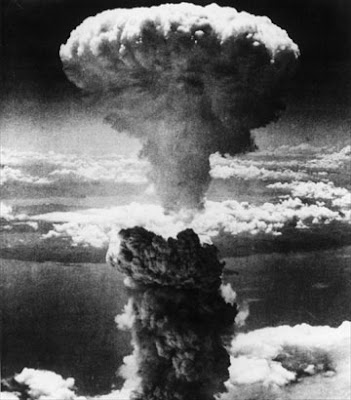
The mushroom cloud picture is the actual photograph of the atomic cloud over Nagasaki 9 August 1945.

The final picture is from the Robert L. Capp collection of ten photographs of the immediate aftermath of Hiroshima. For more information go to Atomic Tragedy.


This article from 'tv news lies'


Written by Reggie
Monday, 04 August 2008 14:36
On August 6 and 9, 1945. After six months of intense firebombing of 67 other Japanese cities, the nuclear weapon "Little Boy" was dropped on the city of Hiroshima on Monday, August 6, 1945, followed on August 9 by the detonation of the "Fat Man" nuclear bomb over Nagasaki. These are to date the only attacks with nuclear weapons in the history of warfare.

In Remembrance of Hiroshima and Nagasaki

When the bombs were dropped I was very happy. The war would be over now, they said, and I was very happy. The boys would be coming home very soon they said, and I was very happy. We showed ‘em, they said, and I was very happy. They told us that the cities of Hiroshima and Nagasaki had been destroyed, and I was very happy. But in August of 1945 I was only ten years old, and I was very, very happy.

The crew of the B-29 was so young and heroic, and in the photo they also looked very happy. For some reason, I clearly remember the name of the pilot, Paul Tibbets. Of course I remember the name of the plane, the Enola Gay. And oh yes, I remember the name of the bomb. It was called Little Boy. That made me smile.

I was so proud to be an American that day because we had done something so remarkable. They said we were the first. We were Americans. We were powerful. But they didn’t say that Little Boy had killed 66,000 people with its huge fireball that fateful day in August. They didn’t say that Hiroshima was not a military target, but a city filled with men and women and children and animals who had no idea they were about to die so horribly. When you’re ten, they don’t always tell you everything.

I don’t think anyone made as big a fuss over the second plane, or its crew. Are they even in the Smithsonian? Second best doesn’t count, I suppose, but I remember wondering why they had done it again. Wouldn’t the war be over anyway, like they said? Weren’t the boys coming home very soon? Hadn’t they already showed ‘em how strong we were in Hiroshima? So they told me that the second bomb was called Fat Man, and that made me smile.

So I was even prouder to be an American that second day. They said this would be the end for sure, and after all, these people were the enemy and you kill the enemy when you can. But they didn’t tell me that Fat Boy had killed 39,000 human beings with another fireball on another day in August. They didn’t tell me that Nagasaki was not a military target, but a city filled with…well, you know. They didn’t even tell me that there were horses trapped in the flames of Nagasaki, because I loved horses and that would have made me sad. But when you’re ten, they don’t tell you everything.

Today I’m no longer ten, and I am no longer happy when bombs fall. And the names Fat Man and Little Boy no longer make me smile because I now know the devastation and horror of burned bodies and twisted metal that result from the mushroom clouds. And I am ashamed that on this day Americans don’t stop to remember what was done. And I am horrified that my government has just killed thousands of defenseless men and women and children and animals who were not the enemy, and that the silence of America is deafening.

Today, I am so very sad that many young people don’t even know about the Enola Gay and the mission of its crew. And I am so terribly ashamed that the war we have just waged has been so devoid of the reality of death and pain. They haven’t told us about the thousands of civilians they have killed. They haven’t shown us the devastation they have caused. They withhold the true numbers of our own military who die each day. They never mention the hundreds who have been terribly wounded. War is surgical and sanitized, they tell us, and a very effective way to liberate people. They speak to us as if we all were ten.

George W. Bush is not ten. He has announced to the world that he, as the leader of this great nation, has the right to use nuclear weapons once again. This time, he says, he has the right to char men and women and children and animals if he “suspects" their leaders of being a threat to us. He is not ten. He really isn’t. Then why is he so very happy? And why, please tell me, is he still smiling?

SIKH WOMEN AT BRISTOL GURDWARA FIND THEIR VOICE

These women's cry of "We're not going anywhere!" reminds me of an old Bob Dylan song:


Genghis Khan
He could not keep
All his kings
Supplied with sleep
We'll climb that hill no matter how steep
We still ain't goin' no where
Whoo-ee! Ride me high
Tomorrow's the day
My bride's gonna come
Oh, oh, are we gonna fly
Down in the easy chair!


The Langar Hall, a really great website dedicated to the open discussion of all things Sikh, alerted me to this situation. Here are some Sikh sisters who seem to have found their voice! I do have a question, however. Why were the women late in registering to vote? Were they not allowed to register, did they not realise they needed to register, did they just not bother to register, or was something else going on? I do notice that Jagbir Singh says

"This is the first year we have ever had women voting at the temple ..."

How incredibly shameful for a religion that is proud of its teaching of gender equality.

And what is it with all those mona Sikhs in that picture? I really want to see some turbans.

Clearly the factionalism that is so prevalent in our gurdwaras is at play in this situation. Do we really need to have shouting matches in public? (At least, it's better than those sword fights, a la Punjab.)How does this make us look to the public at large? When will we grow up?

From Mail Online:


Wednesday, August 06 2008
Riot vans sent to Sikh temple after women denied vote
By Daily Mail Reporter
Last updated at 2:18 PM on 04th August 2008


Dozens of police in riot vans were called to a disturbance at a Sikh temple - after women were denied the right to vote.

Trouble flared when 79 women were refused entry to vote in management elections at Bristol Sikh Temple on Sunday morning.

Worshippers began jostling each other and a pack of women surrounded a man's car and attempted to roll it over.


Police in riot vans were called to a disturbance at Bristol Sikh temple - after women were denied the right to vote

Six riot vans were dispatched to close the road in Fishponds, Bristol, and one man was arrested and cautioned for a public order offence during the seven-hour stand-off.


Voting finally finished at 4pm and resulted in three women being voted onto the management committee for the first time in the temple's history.


Shopkeeper Paul Mathew , 52, who runs J and V Fine Foods 50 yards from the temple said: "It was terrifying. There were skirmishes and people pushing each other.


"A man caused trouble inside the temple then it spilled out onto the street.


"Women were blocking his car and trying to push it over while he was still inside clinging to the steering wheel.


"It was very frightening. People were jostling and using threatening words to each other.


"Women were shouting abuse at men and they were retaliating but I couldn't understand it because it was in their own language." The dispute centres on two warring factions in the temple's 650-strong membership over whether women should take part in elections.


The situation came to a head when 79 women turned up to vote on Sunday morning.


Their opponents said they were not entitled to vote because they had not registered in advance.


Voting was due to start at 10am but it was delayed until midday when Chief Inspector Rob Dean of Avon and Somerset police arrived to mediate between the two sides.


One frightened elderly neighbour who watched the drama from her living room window said: "I saw a crowd of mainly women and children stood on one side of the road and men on the other.


"They were fronting each other up and shouting abuse across the road. The women were screaming 'we're not going anywhere'.


"It was really quite heated and there was a big scuffle of people that looked like it was going to turn nasty.


"There have been rows before that have spilled out onto the streets form the temple but never as big as this one."


The fracas ended at around 5.30pm and when votes were counted three female candidates Anita Kaur, Sheila Kaur and Narinder Kaur, were elected to the management committee for the first time.


Temple spokesperson Satjeevan Kaur said the election was an historical moment for Sikh women in Bristol.


She added: "We are going to be equal to men and to make decisions equal to the men.


Jagbir Singh, 51 from Horfield, is a committee member at the temple and has been involved with it since 1977.


He said: "This is the first year we have ever had women voting at the temple but now a lot of extra women have come down at the last moment, after the end of the agreed time period for registration.


"A lot of time and effort has gone into this and it's been done very fairly." Chief Inspector Dean said: "The elections were delayed for a variety of reasons and we have been involved in trying to help both parties through the negotiations.


"There are allegations of malpractice on both sides and our issue is to ensure that it doesn't come to violence.


"There are 650 registered members at the temple and, while this isn't an issue of the community against the police, there are two factions of the community here who can't reconcile their differences."

© 2008 Associated Newspapers Ltd

05 August 2008

Mool Mantar

This is Harshdeep's rendering of the Mool Mantar from Rang De Basanti. Only the video on this one doesn't have the professional actors from the movie. Much nicer to watch.
And always perfect to listen to. I think this is the most beautiful version I have heard.


Except, of course, the one with my Dad, my husband and our son.


http://www.youtube.com/watch?v=nNb1efvF9J0&feature=related

02 August 2008

WE WILL NEVER BE SILENCED

VAHEGURU JI!

What will it take to teach those fools in New Delhi that we will never be defeated? Their arrests, their tortures, their killings are just useless gestures. We are still here, still active, still vocal.
From Sikh Sangat News:

India's brutal campaign against Sikh lawyers, rights and Political Activists
Posted in: Asia
By IHRO - https://www.ihro.in/?q=node/106
Aug 1, 2008 - 10:43:50 PM


This paper on ‘The human rights situation in Punjab during 1984-94’ was presented at ICSSR Complex, Punjab University, Chandigarh, on July 2, 2006, by International Human Rights Organisation (IHRO) during a Panel Discussion held by The Voices For Freedom

India had launched a brutal campaign against Sikh lawyers, and human rights and political activists, in the state of Punjab. Main targets were those who have been opposing tooth and nail the state repression let loose on Sikh activists engaged in the ongoing Sikh struggle for an independent and sovereign state, and rendering legal aid to them in judicial courts. At least three Sikh lawyers, one human rights activist’s son and a journalist were liquidated at the hands of the Indian security forces as a result of this campaign. Many others were arrested, harassed and detained in jails only because of their activities as lawyers, journalists, leaders of political groups or religious organisations.

According to International Human Rights Organisation (IHRO), at least 13 lawyers and about 20 human rights and political activists were said to be on the police’s hit-list, and the then Punjab and Haryana High Court Bar Association president Gian Chand Dhuriwala had advised some of the “marked” lawyers to shift elsewhere for saving theirs lives. Three Sikh lawyers- Kulwant Singh of Ropar, along with his spouse and two-year-old son; Jagwinder Singh of Kapurthala and Ranbir Singh of Bathinda- were done to death by the police after clandestinely taking them into custody.

Earlier, Justice Ajit Singh Bains, a 70-year-old former High Court Judge and human rights activist, journalist Sukhdev Singh and advocates- Gurcharan Singh Ghuman and Jagmohan Singh- were arrested and detained in jails for months for their professional and human rights activities. Gurdip Singh, managing editor, Aj Di Awaz, has been terrorized into hibernation. Journalist Ram Singh Billing was picked up by the police, and he is feared to have been killed in custody. Avtar Singh Mander, a journalist of Ajit still remains disappeared at the hands of the police. And IHRO vice-president Dr. G. S. Mavi’s son Atamjit Singh, an 18-year-old BSc student, was picked up by the police and shot dead in cold blood in January 1992.

The murderous campaign reached its zenith when the police clandestinely liquidated the former Akal Takht (the highest temporal and spiritual seat of the Sikhs) Chief Gurdev Singh Kaonke in custody.

And, the then Punjab Chief Minister Beant Singh used to issue “threats” to Shiromani Gurdwara Parbandhak Committee (SGPC) chief Gurcharn Singh Tohra and Akali Dal president Simranjit Singh Mann to mend their ways. Otherwise, “they will be arrested under TADA,” had said Beant Singh. The chief minister had wanted them to shut their mouth so that his administration could go on unchecked particularly on the law and order front.

The energies of the IHRO were directed, during that period, against the manner in which New Delhi had tried to suppress and crush democracy in India, especially Punjab and Kashmir. Against this background, the IHRO had then become the target of the Indian State.

The residence of IHRO General Secretary Mohinder Singh Grewal was raided on March 21, 1993, by the Ludhiana police. They picked up his 74-year-old father Rajinder Singh and took him to the Crime Investigation Agency (CIA) staff. He was set free in the evening on the condition that we would produce Grewal, the next morning. Grewal went to the CIA police station along with his brother Apinder Singh, then a Councillor of the Ludhiana Municipal Corporation. The councillor was asked to leave, and Grewal was interrogated by a Delhi Police team, the whole day.

The police team questioned about Grewal’s telephonic conversation with his maternal uncle’s son Sukhminder Singh Sandhu, and then lodged in a New York jail. He was made to sit in the police station till 9:00 PM. Thereafter, he was released with an instruction to present himself the next day for further interrogation.

On March 23, the Delhi police team was assisted by a Superintendent of Police (Detective), Ludhiana, B. S. Gill. During interrogation, Grewal was manhandled and threatened for the consequences. Grewal informed Sukhminder’s defence lawyer Ms Mary Pike in USA about the incident vide his letter of March 25, saying: “B S Gill manhandled me and gave blows on my head. He asked me, “Have you stopped us by doing investigation reports against us (the police)? Could you do any thing in the case of Kulwant Singh Saini advocate? He also threatened that he would subject me to all methods of torture practically and thereby enable me to make a personal report on torture. He further threatened that he will also see D S Gill (Chairperson, IHRO), the same way soon.”

After this, taking him along, Grewal’s home was raided and his personal telephone directory confiscated. They had probably noted down the telephone numbers of his friends and relations. He was released in the evening and again asked to come the next morning.

On March 24, he was also interrogated by an Intelligence Bureau (IB) team for more than four hours. They asked him about the IHRO network in India and abroad. The police party allowed him to go home, asking him again to come to the CIA staff, the next afternoon. When Grewal went there on March 25, the investigation teams had left for Delhi.

After few days the Delhi team again visited Ludhiana. They tried to contact Grewal. He was not there then. The team, before leaving for Delhi, told Grewal’s brother that they would contact Grewal in the very near future for the further interrogation. The investigating team did not tell why they were after Grewal.

It was felt that he was being harassed and maltreated only because of his relation with Sukhminder Singh Sandhu. Grewal, along with D. S. Gill, was also a co-defender from India in the extradition proceedings pending against Sandhu and Ranjit Singh Gill in a US court.

Being the general secretary of the organization, Grewal was first among the investigators of the police crimes and was, therefore, targeted for exposing the police actions. Earlier, IHRO administration secretary Gurbhajan Singh Gill too was kept in illegal custody for a week. So, we (IHRO) saw a plot in it, thinking that “the police may implicate him or other IHRO activists in some criminal case or harm them physically.”

The IHRO chapters abroad, then, alerted the international public opinion and governments against the nefarious designs of the Indian administration and the police. And that lobby worked well, and that was why we could protect Grewal and other activists’ lives from the brutal police.

We, in IHRO, therefore, make fervent appeal to the international human rights agencies and defenders, including foreign missions here in India, of course, including The Voices For Freedom, to take notice of these state brutalities and to use their good offices for getting these matters judicially examined and then for pushing all those, including bureaucrats and politicians, found guilty.

© Copyright 2008 by

Picture courtesy of Simmal Tree

International Human Rights Organisation (IHRO), of the Indian subcontinent, is a NGO, with national focus and overseas lobby network. It agitates both in India and internationally For anyone wishing to join IHRO

Click to join IHRO

Click to join IHRO

31 July 2008

Farewell To Ishmeet

This is from Just Sikhs. I do not know who the woman in the picture
is. I suspect it may be his mother:


GOOD-BYE, MY SON


Ishmeet Singh’s body was brought home amid the chants of “Waheguru” here this afternoon.

When the van carrying his body, escorted by his father, relatives and friends, entered the street near his house, neighbours broke down. Women were seen running along the van, crying bitterly.

His shattered father, Gurpinder Singh Sodhi, walked ahead of his son’s body when it was taken inside the house. A proud father had suddenly aged.

His mother, Amritpal Kaur, sat next to the body. She uncovered Ishmeet’s face and kissed him before breaking down. She had not cried for the past two days, leaving the family worried.

As the family grieved, those witnessing the scene could not control their emotions. It seemed the tragedy had struck not only Ishmeet’s family, but also those present there.

Later, the body was kept outside in a glass chamber. The head was covered with a saffron cloth. People who loved him queued up in the sultry weather to have a last glimpse of Ishmeet, whom they had once cheered to victory.

Several elderly people, who had trouble walking, waited patiently for their turn to see him once more.

“Ishmeet’s family members are not alone in their grief. We are with them. We all have lost a promising and talented son,” said Narinder Kaur (70) from Dugri, while summing up the sentiments of scores of Ludhianvis.

thetribune.com